


Synopsis
The film “I Believed” depicts the story of Ada and Danny from Kibbutz Nir Oz, and the two distinct paths they take to cope with the trauma of October 7th. Kibbutz Nir Oz, where forty people were murdered and seventy-seven were abducted, was left abandoned to the terrorists for many long hours. The film reveals personal testimonies from Ada and Danny, reflecting not only a personal fracture but also a communal and identity crisis.
Ada portrays a rich and meaningful life in the Kibbutz prior to October 7th. She was an educator, led community committees, and worked to promote coexistence. Following the events, and in the wake of her time in captivity, she experiences a deep loss of faith in the connection between the peoples. She describes a sensation of a severed limb, emphasizing that the Kibbutz will never be the same. Nevertheless, she is building a new life for herself in a different apartment, continues to teach, is surrounded by friends, and is attempting to restore her creativity and write “the book of her life.” She seeks to look forward with a note of optimism.
Danny, in contrast, refuses to leave Nir Oz. He speaks of loyalty to the place where he has lived for sixty years. Danny continues to believe in coexistence and the need to invest in peace, even after such a severe blow. He hopes Ada will return and reconsider her stance. Through these two voices, the film presents two options for coping with trauma: rebuilding in a new space, or remaining loyal to a place that holds both pain and deep roots.
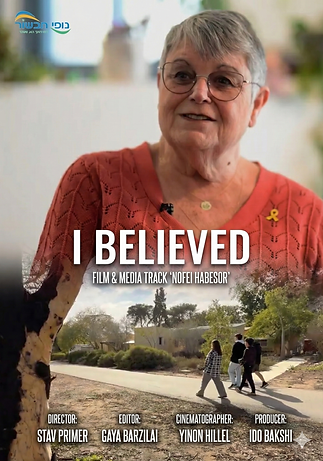
Credits
Director: Stav Frimer
Cinematography: Yinon Hillel
Producer: Idan Bakshi
Editor: Gaya Brazil
Editing Mentor: Noa Frimer
Mentor Teacher: Eyal Bribram
School: Nofei HaBsor
Lesson Plans
Between Fracture and Rehabilitation

Loyalty to Place and Faith in Peace
Cinematic Language
The film “I Believed” employs a restrained yet profound cinematic language. The focus lies not on dramatic events, but on facial expressions, silences, and direct speech. Ada and Danny’s testimonies are shot with soft lighting and subtle camera movements, allowing the viewer to draw close to the internal fracture experienced by both.
The film creates a visual contrast between two spaces:
-
The open space of the Kibbutz, transformed into a scene of loss.
-
The new spaces Ada has built for herself, filmed with stable compositions to convey a sense of rehabilitation.
The editing allows room for breaths, pauses, and emotionally charged moments of speech. This creates a space where words and facial expressions become the central image. The film avoids reenactments or special effects; this choice enhances the sense of authenticity, anchoring the experience in human depth rather than merely in the historical record of the event.
The dialogue between Ada and Danny is primarily framed through the contrast between them. The camera captures both of them in lingering shots, allowing the viewer to grasp the complexity of a fractured community searching for a way to live. In this way, the cinematic context emphasizes that the story is not just about trauma, but about choice: a choice between personal rehabilitation and returning to a wounded place; between severance and hope; between movement and roots.